About the project
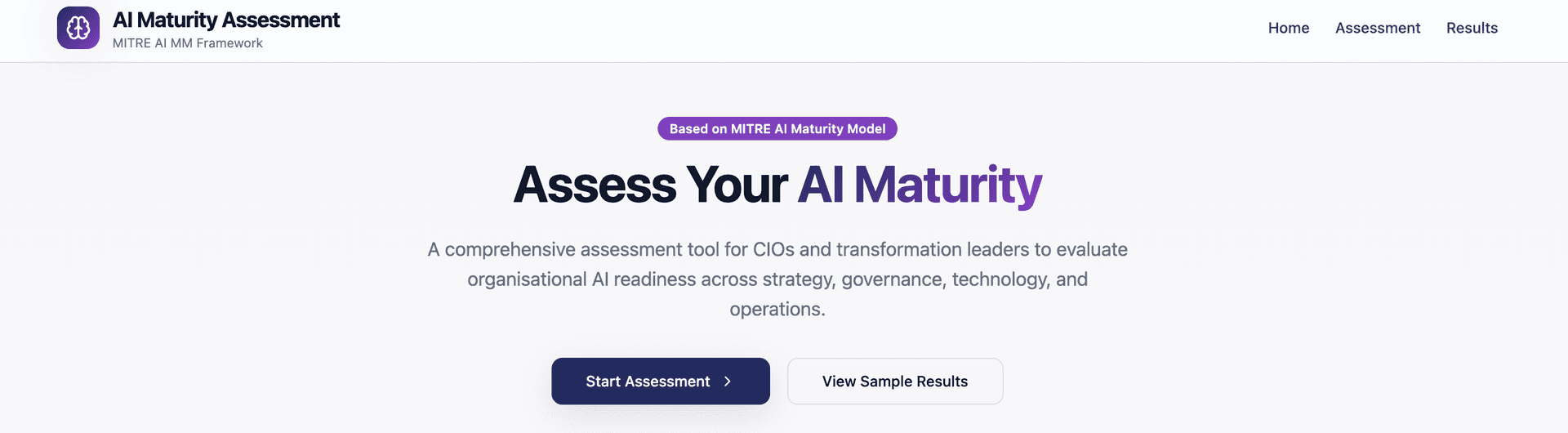
This project is a streamlined assessment tool designed to help executives evaluate their organization’s AI maturity using the MITRE framework. The tool translates a complex, standards-based assessment into an accessible experience tailored for senior leaders, enabling them to quickly understand where they stand across key AI capability dimensions. By structuring questions and scoring around MITRE’s established methodology, it provides a consistent, objective view of AI readiness. Executives can use the resulting insights to prioritise investments, identify capability gaps, and align AI initiatives with strategic business goals in a clear and data-informed way.
Problem
Many executive teams struggle to accurately gauge their organization’s AI maturity and readiness. Existing assessments are often highly technical, inconsistent, or lack a clear connection to strategic decision-making. As a result, leaders may overestimate or underestimate their capabilities, misallocate resources, or pursue AI initiatives without a solid foundation. Without a structured, recognized framework, it is difficult to benchmark progress, communicate maturity levels across the organization, or justify AI investments to stakeholders in a credible, standardized way.
Solution
The tool operationalizes the MITRE AI maturity assessment framework into a guided, executive-friendly experience. It structures the framework’s dimensions into clear, targeted questions that executives can answer without deep technical expertise. Responses are synthesized into maturity scores and profiles that highlight strengths, weaknesses, and priority areas for improvement. By grounding the assessment in MITRE’s methodology, the tool offers a repeatable and defensible way to evaluate AI capabilities, making it easier for leaders to interpret results, benchmark over time, and communicate findings to boards, partners, and internal teams.
Impact
By simplifying the MITRE AI maturity framework for executive use, the tool helps organizations make more informed, strategic decisions about AI adoption and investment. Leaders gain a clearer view of their current state, enabling them to focus on the most critical capability gaps and sequence initiatives more effectively. This leads to better-aligned AI roadmaps, reduced risk from poorly scoped projects, and stronger stakeholder confidence. Over time, repeated assessments can track progress, support continuous improvement, and provide evidence of AI capability growth to internal and external stakeholders.